
Jurnii: Assessing operators’ Premier League promo playbooks ahead of the new season
Following Jurnii’s World Cup analysis for EGR, the marketing intelligence platform explores how bookmakers laid out their stalls over the summer in the build up to the opening round of fixtures


The Premier League pushed its opening weekend back a week this year, leaving 33 clear days between the World Cup final on 19 July and Arsenal playing Coventry on 21 August (see Jurnii’s World Cup coverage for EGR here). Every trading and marketing team in the country got the same lead time on the same event. It is about as clean a test of promotional readiness as this market produces.
Ladbrokes and Coral won it. Between them, they took a third of all boost volume across the opening weekend, up from roughly a fifth during the World Cup, and Ladbrokes alone published 335 Premier League boosts in four days, the largest book of any brand.
They did it while activating late, and while conceding among the least margin-per-boost of any operator in the market. Almost every headline number would have told you they were behind.
The activation date
The finish to the World Cup was unanimous. Boosts went to zero overnight and 11 of the 12 brands tracked here published their last one on 19 July itself.
The restart was not. Dated by the first boost containing a Premier League club, the market looked brisk: 10 of the 12 inside a fortnight. Look at what those boosts were and most of them evaporate. LiveScore Bet’s was a bet builder on a Liverpool friendly. Bet365’s was an eight-leg BTTS across Karlsruher, Rangers, Cannes and Napoli. Ladbrokes’ was a 10-fold running through Dundee United, Club Brugge and a Northern Territory league match in Darwin.
None of those are a Premier League activation. They are summer accumulators that happen to contain UK clubs.
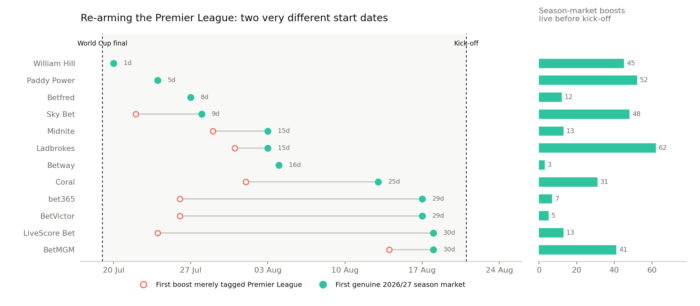
Counting only genuine season markets, meaning an outright, a special or a boost published against the league itself, the table stretches from one day to 30. William Hill priced Arsenal for the title on 20 July, the morning after the final. Paddy Power followed on 24 July with a market on new boss Andoni Iraola to leave the Liverpool job, and then Betfred pricing Bournemouth to make the top 10 under the headline “No Iraola? No problem” on 27 July.
Then it stops until Midnite and Ladbrokes on 3 August. Coral took 25 days. Bet365 and BetVictor took 29. Ladbrokes took 15 days to publish a season market and still ran the biggest book in the country when the whistle blew.
The boost percentage
Boost percentage is the number on the banner. It is not what the boost costs. A 20% boost on an even-money shot gives away several points of margin. The same 20% on a 25/1 outright gives away a fraction of one.
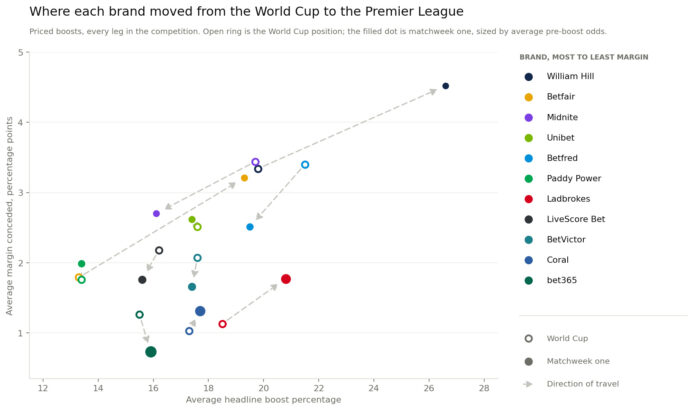
William Hill is the outlier in both directions. They advertise 26.6%, the loudest headline in the market, and concede 4.52 points of margin, the most anyone pays. They arrived there from 19.8% and 3.34 points during the World Cup, so raised the price of a boost by more than a third for the domestic season. Its average pre-boost odds are 3.92, which is the mechanism: they boost short prices, and short prices are expensive.
Ladbrokes and Coral sit at the opposite corner and look nothing like their headline suggests. Ladbrokes advertises a 20.8% boost, second only to William Hill, and concedes 1.77 points, seventh of the 11. Coral advertises 17.7% and conceded 1.31 points. Boost a long shot and the percentage looks enormous while the implied probability barely moves. Both did increase real spend against the World Cup, but from a very low base.
Bet365 took the same approach further than anyone, conceding 0.73 points at average odds of 23.28, and it cut that figure by 42% from the World Cup while nudging its headline up. Paddy Power held its headline at 13.4% across both competitions, though its cost-per-boost still edged up from 1.76 points to 1.99.
The acca assumption
Ideally, 10 matches on a Saturday is supposed to be what makes the Premier League an accumulator market. A tournament gives you one or two games a day; a domestic weekend gives you a full slate, and the received wisdom is that operators build across it.
Across the market, 68% of Premier League boosts in matchweek one were built inside a single fixture, up from 61% at the World Cup. Cross-match accumulators fell over the same period, from 23% of the book to 14%. We found 85% of Premier League boosts covered one match only, against 79% at the World Cup. Operators did not spread across the card. They went deeper into one game.
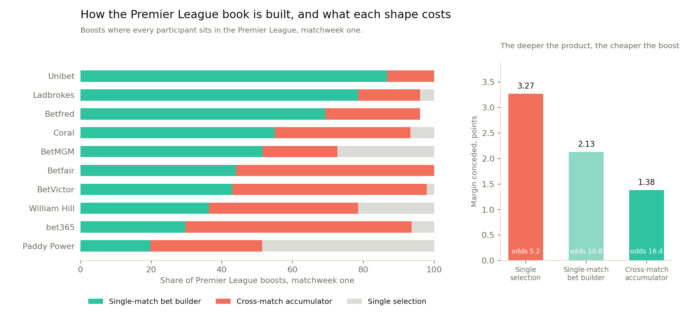
There is a reason, and it is the same reason that runs through the pricing. Depth is cheap. A single Premier League selection concedes 3.27 points of margin at average odds of 5.19. Build the same boost inside one match and it concedes 2.13 at odds of 10.78. Spread it across matches and it concedes 1.38 at odds of 16.36. The deeper the product, the longer the price, and the less a generous-looking percentage actually costs.
That is the whole pricing story from the previous section expressed as product design. William Hill concedes the most margin in the market because 22% of its book is plain singles and only 36% is bet builders. Ladbrokes concedes among the least because 79% of theirs is built inside a match. Neither brand needs to be more or less generous than the other. They are selling different shapes.
What is left when you correct
A domestic season rewards a different operation from a tournament. Brands that ran the largest World Cup boost programme in the market have struggled to keep the momentum when Premier League returned. Betfred halved. The brands that gained were the ones with an estate to run and a fixture list to run it against, and they spent August in racing before pivoting hard: Ladbrokes put 48% of its gap volume into horseracing.
So, the correct reading is close to the opposite of the surface one. Ladbrokes and Coral arrived last, boosted long prices that cost them little, and won the weekend on volume. William Hill did the opposite in every respect: first to activate, loudest headline, shortest prices, most margin conceded and the largest increase in real cost of anyone moving into the domestic season. Both approaches took share. Only one of them was expensive.
Whether either playbook holds once the fixture list stops being a launch event is the question the next few weeks will answer.