
How to win with AI: the executive playbook for gaming growth
In a follow up to their presentation at EGR’s Power 50 Summit, Meta’s Kaan Camgoz and Vesna Gordon outline how to stay ahead when AI is rewriting the rules

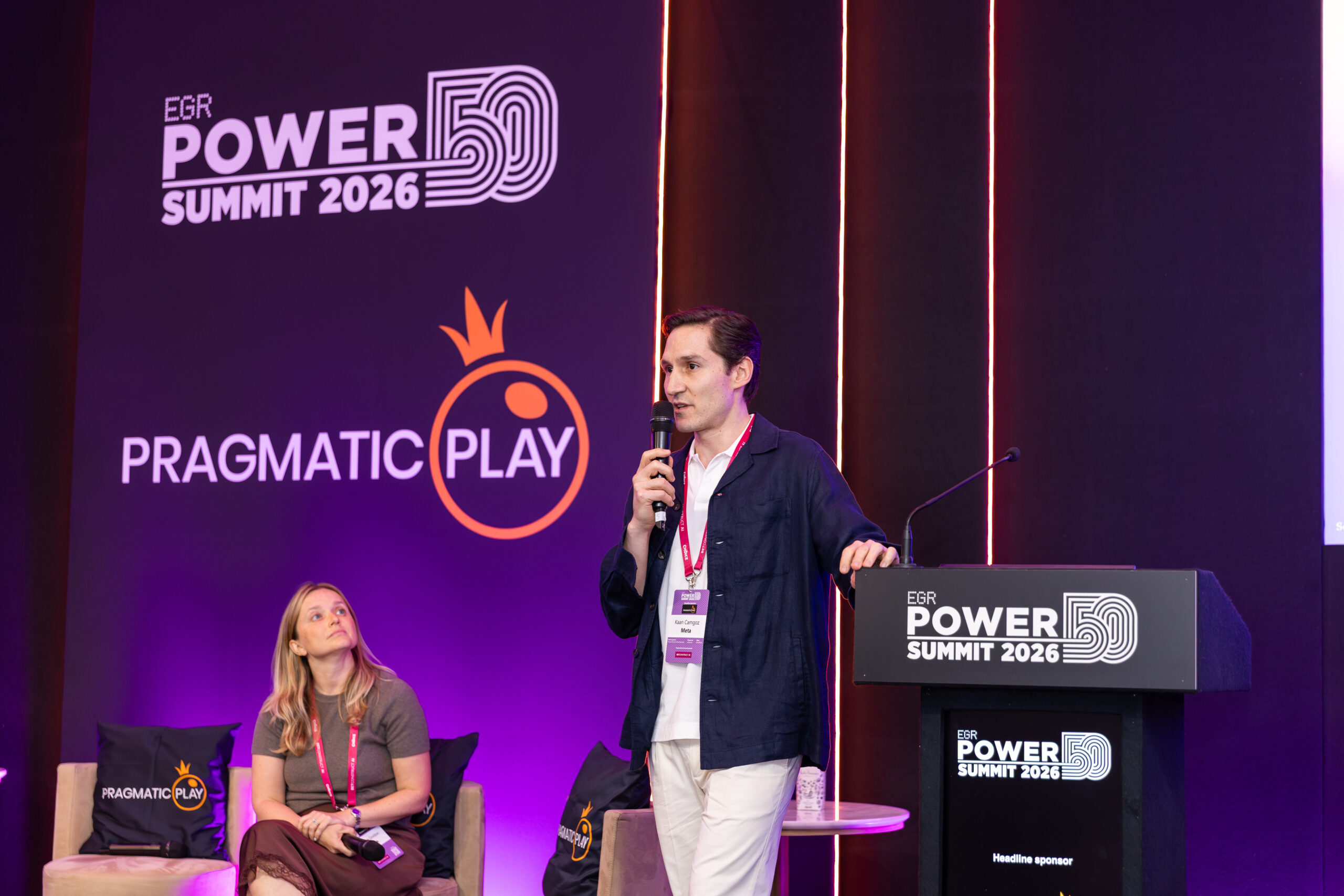
For real-money gaming (RMG) operators across EMEA, the strategic landscape is shifting fast. Tax pressure is mounting, player behaviour is evolving, Gen Z is entering the market with fundamentally different habits, and regulation continues to tighten. Against that backdrop, the question facing every CEO and chief marketing officer is deceptively simple: how do you actually use AI to grow?
At the EGR Power 50 Summit earlier this month, Meta laid out a clear answer – not with theory, but with a practical playbook built around a central thesis: humans set the strategy; AI and automation execute at scale. The best talent in any organisation shouldn’t be doing the heavy lifting – they should be setting direction and letting the machine deliver.
To unlock that, operators need to master four pillars.
Pillar one: Feed the machine the right signals
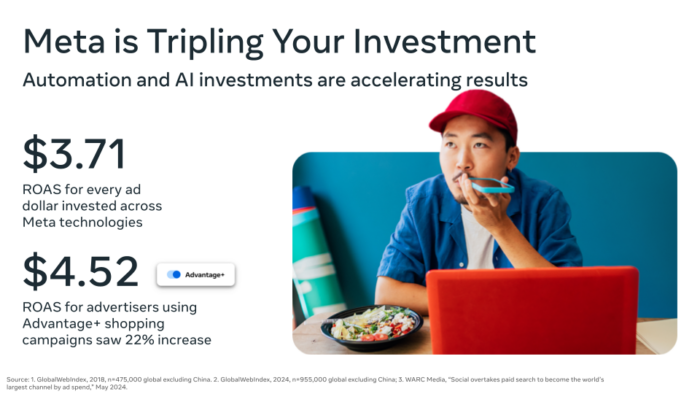
Every dollar invested across Meta technologies now returns $3.71 (£2.75) on average – rising to $4.52 when advertisers deploy Advantage+ shopping campaigns (source: Meta internal data, 2025). But that return is only as good as the data feeding the system.
Meta’s Lattice technology brings multiple AI models together so each one improves the other, enabling real-time decisions on which ad to show, which creative variation to serve and what bid to place. The critical input comes from the operator: high-quality signals that reflect what the business actually values.
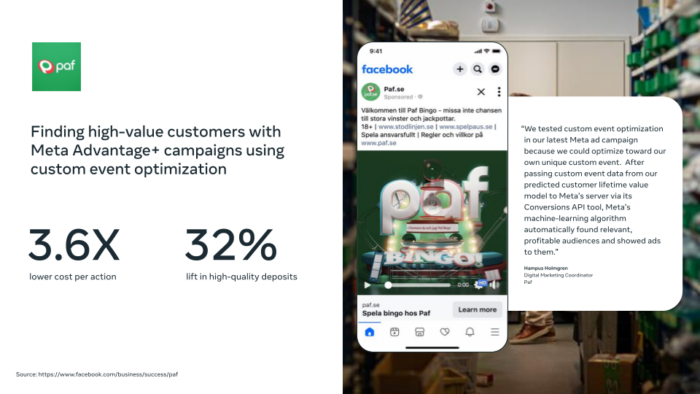
Paf demonstrated this perfectly. The Nordic operator piped its own predictive lifetime-value model directly into Meta via the Conversions API, telling the system exactly what a high-value customer looked like. The result: a 3.6x lift in high-quality deposits (source: Meta for Business, PAF case study). The takeaway is clear – if an operator’s Event Match Quality score sits below 8.0, efficiency is being left on the table.
Pillar two: Measure what’s real, not what’s convenient
Consumer discovery has fundamentally shifted. According to analytics consultancy Kantar, over 50% of players now discover new games through Meta’s feeds, overtaking search as the dominant channel. Yet many operators still rely on last-click attribution, which means they are blind to where value is actually created.
That blindness is expensive. Research from Analytic Partners shows click-based optimisation wastes up to 35% of spend on non-incremental conversions. Gen Z compounds the challenge as they are twice as likely to purchase without clicking an ad (source: eMarketer, 2024). A global analysis of 307 studies confirms Meta ads drive 1.45x more true incremental value than standard attribution reports.
The starting point is simple: run a geo switch-off test. Leave Meta on in one market, turn it off in an equivalent market, wait four to six weeks and compare actual revenue. Product Madness adopted this approach with quarterly Conversion Lift studies, achieving 3x better reporting accuracy on Android and 5x on iOS – giving the business confidence to scale spend where it genuinely drives net-new players (source: Meta for Business, April 2025).
Pillar three: Scale creative like a performance channel
With over 60% of time on Instagram and Facebook now spent on video, static-only strategies are invisible for more than half of the audience. Creative is the new targeting.
Partnership Ads – where brands amplify content directly from a creator’s handle – represent the single biggest underleveraged format in RMG. Best-in-class advertisers globally allocate over 20% of spend to Partnership Ads; in RMG, it is just 5%. Operators adopting the format see a 19% reduction in acquisition costs (source: Meta analysis, 15 advertiser tests, 2023).
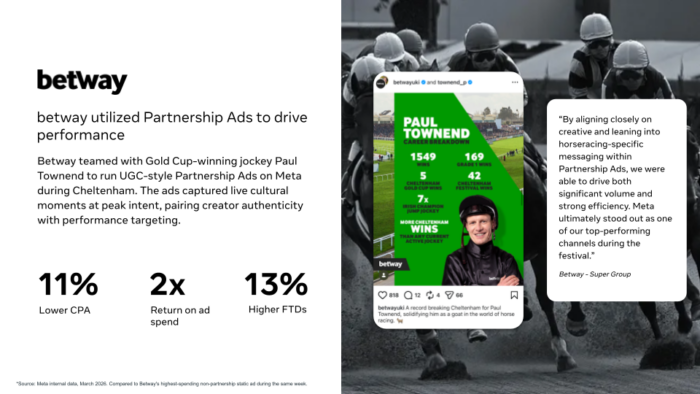
Betway’s Cheltenham campaign set the benchmark. UGC-style Partnership Ads featuring Gold Cup-winning jockey Paul Townend delivered 2x ROAS, 11% lower CPA and 13% more first-time deposits versus non-partnership creative (source: Meta internal data, March 2026). With 240 million sports bettors set to follow the FIFA World Cup on Meta platforms, operators building a video-first, creator-led production cycle now will be best positioned to capture that moment.
Pillar four: The +1: build AI-native talent
The final pillar is people. As Mark Zuckerberg stated earlier this year, 2026 is the year AI dramatically changes how organisations work. Meta’s own ambition is to make every team 10x more productive through AI – embedding AI-native ways of working, dedicated AI workflow time and hiring talent that can manage fleets of AI agents, not just prompt a single model.
For operators, the implication is the same. The future of media buying is pure science – built on automation, AI-powered creative production and advanced measurement intelligence. The organisations investing in AI talent now will compound that advantage for years to come.
The bottom line
Almost every operator is using AI today. The question is who is winning with it? The answer lies in mastering signals, demanding incremental measurement, scaling native creative and empowering AI-native talent. Nail all four, and AI shifts from a line item to a genuine competitive edge.

Kaan Camgoz is head of industry, RMG & console, EMEA at Meta, where he leads Meta’s partnerships with real-money gaming, console and sports betting brands across the region.

Vesna Gordon is head of marketing science at Meta for EMEA Gaming, CEE and Israel regions. Her core focus at Meta is helping brands leverage advanced data driven insights and measurement frameworks to drive incremental growth and measure effectiveness or digital strategies.
Before joining Meta, Gordon spent over 15 years within the digital ad measurement and mobile ecosystems, a tenure defined by her expertise in research and analytics and experience as a startup founder.